|
Raghav Singhal I'm currently an AI PhD student in the Computer Science department at EPFL. I am fortunate to be advised by the amazing Prof. Robert West & am a contributor to the Apertus project (the biggest fully open & compliant training run & LLM at the time).Previously, I was a researcher at Mohamed bin Zayed University of Artificial Intelligence (MBZUAI), where I worked with Prof. Praneeth Vepakomma. Prior to this, I graduated from IIT Bombay with a Bachelor's in EE & a Master's in AI/ML. For EPFL students: If you are interested in a project, please feel free to reach out via mail. I'm very happy to supervise motivated students! Email / / / / |
|
ResearchMy research interests currently revolve around pretraining, data, & robust alignment of language models. Some directions that I am currently interested in are:
Check out my Google Scholar for a complete list of publications. * denotes equal contribution. Selected projects are highlighted. |
|
Synthetic Persona Pretraining: Alignment from Token Zero
Julian Minder*, Viktor Moskvoretskii*, Raghav Singhal*, Robert West project page / arXiv / thread /  models & data /
code models & data /
code
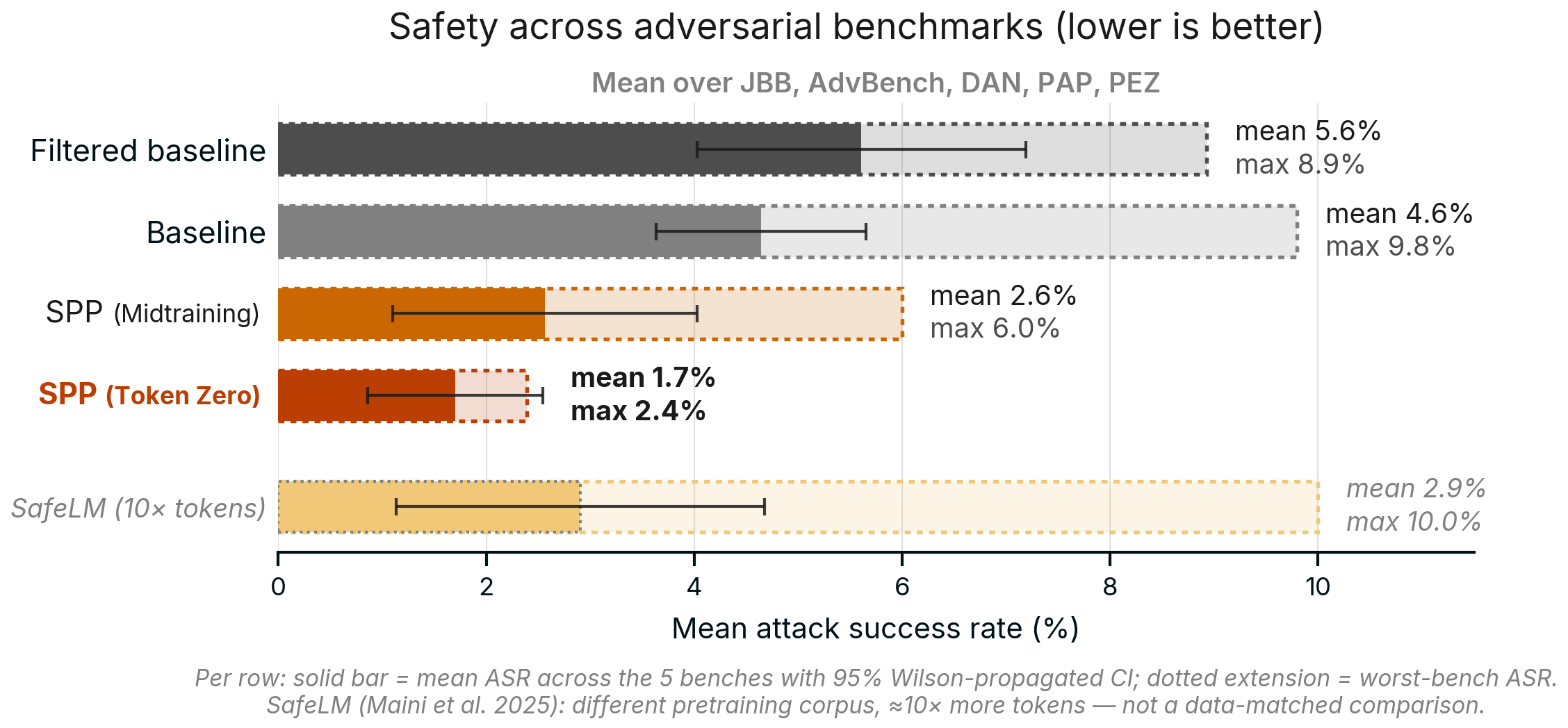
Preliminary: blog post / thread Instead of aligning models at the end of training, we do so from the very start of pretraining — from token zero. We annotate pretraining documents with first-person moral reflections derived from a constitution, pretrain on them, then bind the assistant to this aligned persona in post-training. SPP models are more faithful to the constitution, less misaligned, & more robust to jailbreaks. Compared to models aligned late in pretraining (mid-training), models aligned from token zero better internalize the constitution's underlying principles: they show different value priorities & are better-aligned on OOD moral dilemmas. We are currently scaling SPP to Apertus 2, a 500B+ parameter MoE trained on 15T+ tokens. I co-led & completed the synthetic data creation for the corpus. |

|
Apertus: Democratizing Open and Compliant LLMs for Global Language Environments
Team Apertus arXiv / models /
pretrain code /
pretrain data /
post-train code /
post-train data /
evals
The biggest fully open & compliant training run & LLM at the time. 8B & 70B fully pretrained open-data open-weights models, multilingual in >1000 languages. Performance equivalent or better than corresponding Llama 3 sizes. |
|
Tandem Reinforcement Learning with Verifiable Rewards
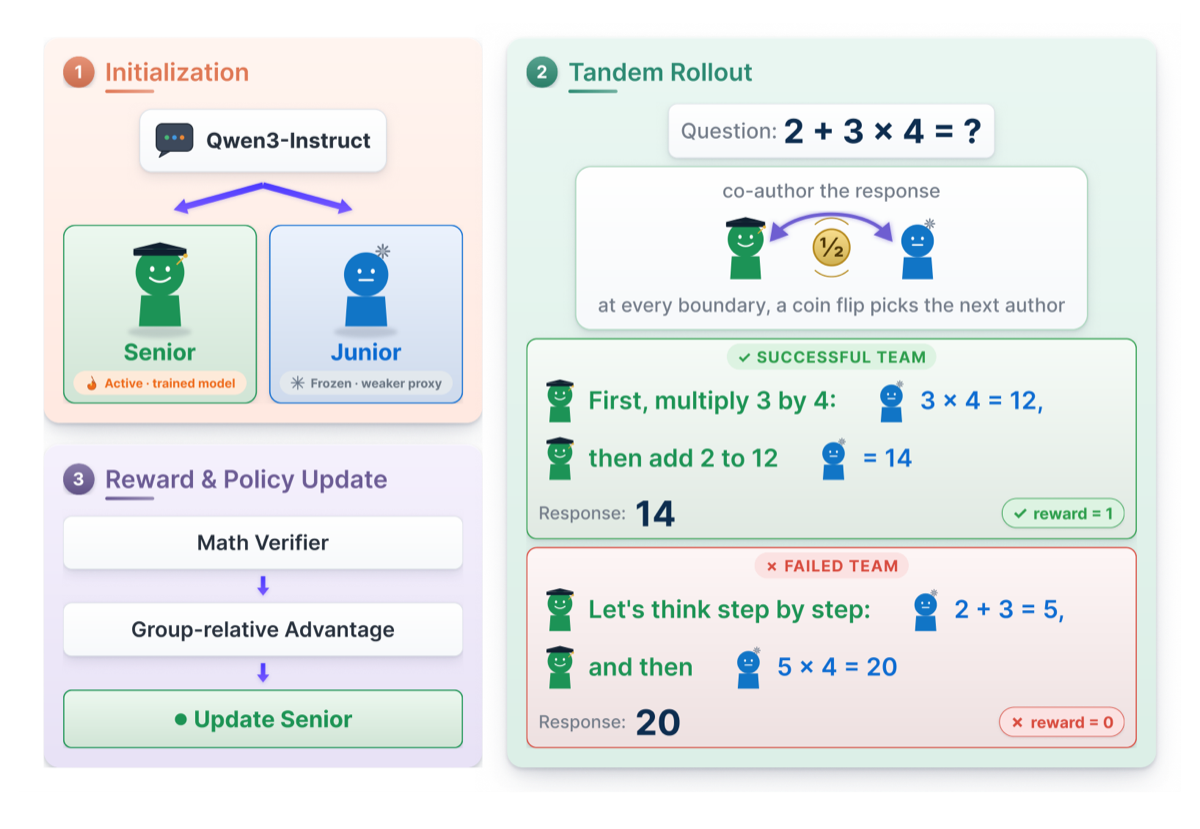
Difan Jiao, Raghav Singhal, Robert West, Ashton Anderson arXiv / code RLVR makes models better at reasoning, but this reasoning drifts away from what weaker partners — models, or humans — can follow. In TRL, a trained senior & a frozen weaker junior alternate stochastically to co-generate every rollout, & the combined rollout is rewarded as a whole. TRL matches vanilla GRPO on solo reasoning while giving stronger handoff robustness, less distributional drift, & a chain-of-thought more legible to the junior. |
|
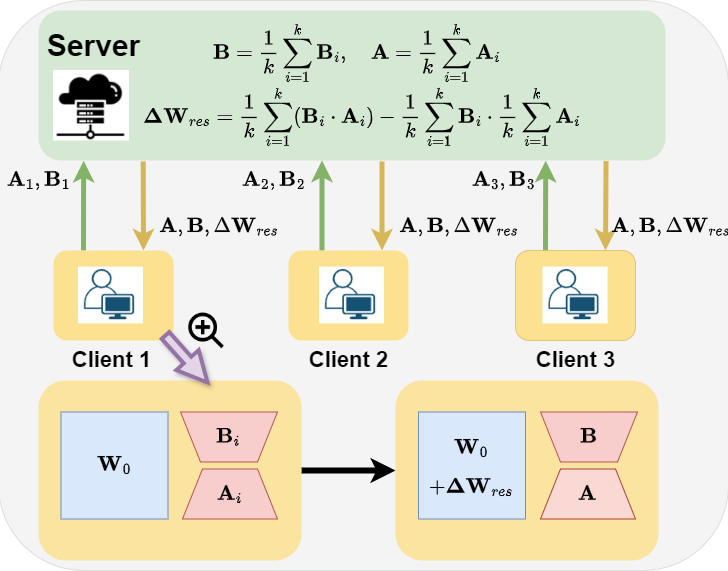
Safety Subspaces are Not Linearly Distinct: A Fine-Tuning Case Study
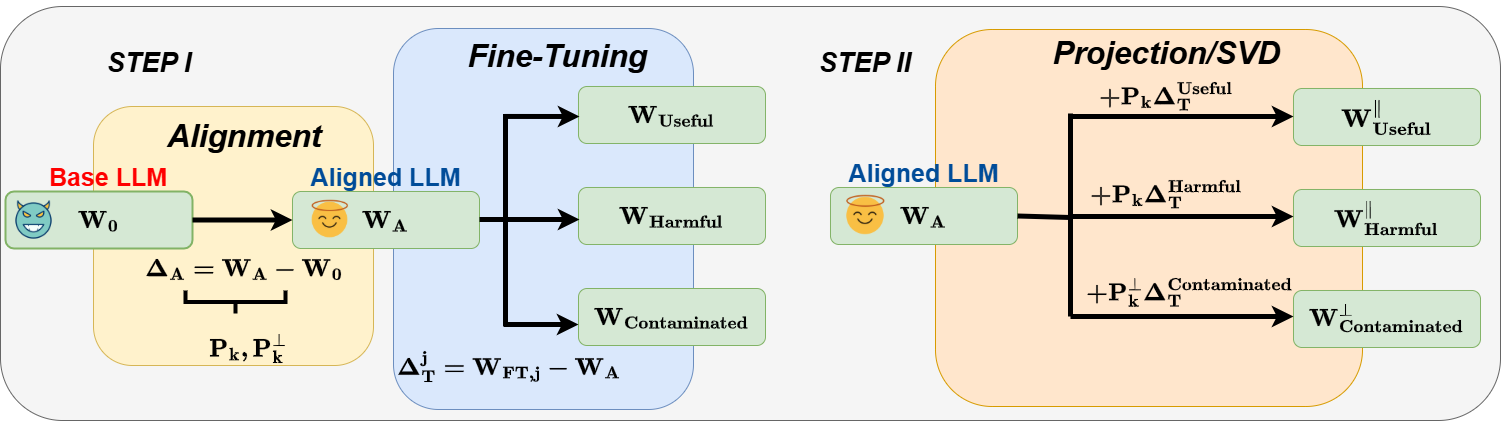
Kaustubh Ponkshe*, Shaan Shah*, Raghav Singhal*, Praneeth Vepakomma ICLR 2026 arXiv / code We show that safety alignment in LLMs is not confined to distinct subspaces (but rather, highly entangled with general ability directions), thus fundamentally challenging the foundation of subspace-based defenses. |
|
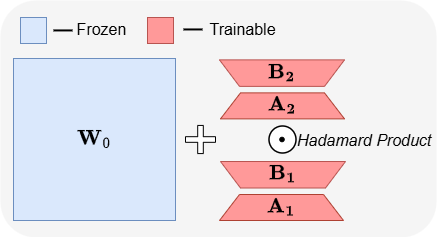
FedEx-LoRA: Exact Aggregation for Federated and Efficient Fine-Tuning of Foundation Models
Raghav Singhal*, Kaustubh Ponkshe*, Praneeth Vepakomma ACL 2025 - Oral (Top 2.2% of submitted papers) arXiv / code We achieve exact aggregation in distributed fine-tuning of LLMs, consistently improving over SOTA. |
|
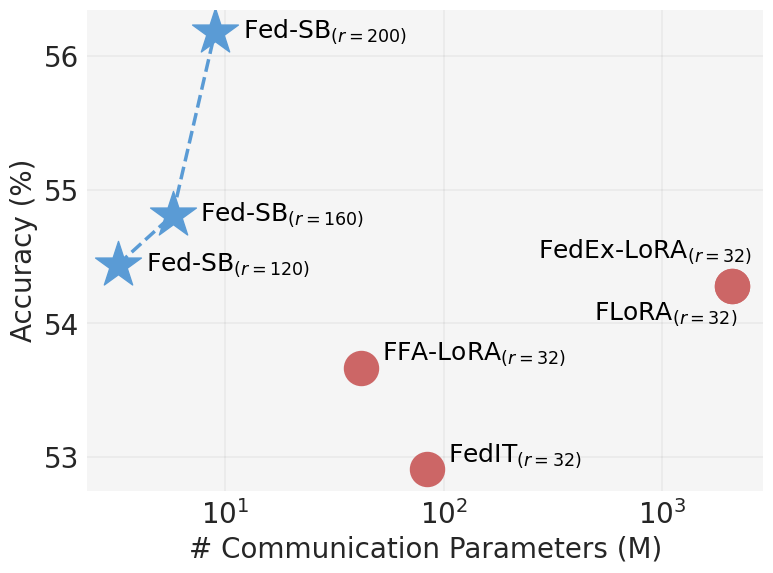
ABBA: Highly Expressive Hadamard Product Adaptation for Large Language Models
Raghav Singhal*, Kaustubh Ponkshe*, Rohit Vartak*, Praneeth Vepakomma ICLR 2026 Abridged at ES-FOMO @ ICML 2025 - Spotlight (Top 9.5% of accepted papers) arXiv / code We introduce ABBA, a PEFT method that enhances expressivity by decoupling low-rank updates from pre-trained weights via a Hadamard product, consistently improving over SOTA methods. |
|
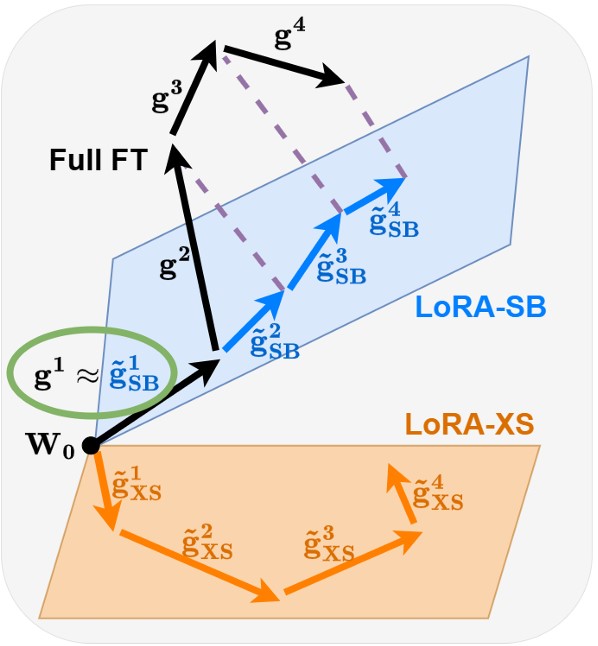
Fed-SB: A Silver Bullet for Extreme Communication Efficiency and Performance in (Private) Federated LoRA Fine-Tuning
Raghav Singhal*, Kaustubh Ponkshe*, Rohit Vartak, Lav Varshney, Praneeth Vepakomma NeurIPS 2026 | TMLR 2026 -J2C Certification (Top 10% of accepted papers) arXiv / code We set a new Pareto frontier for distributed fine-tuning of LLMs, achieving SOTA performance, stronger privacy guarantees, & up to 230x lower communication costs. |
|
Initialization using Update Approximation is a Silver Bullet for Extremely Efficient Low-Rank Fine-Tuning
Kaustubh Ponkshe*, Raghav Singhal*, Eduard Gorbunov, Alexey Tumanov, Samuel Horvath, Praneeth Vepakomma Abridged at SCOPE @ ICLR 2025 arXiv / code We provably achieve the best approximation of full fine-tuning in low-rank spaces solely through clever initialization, outperforming LoRA while using up to 90x fewer parameters. |
|
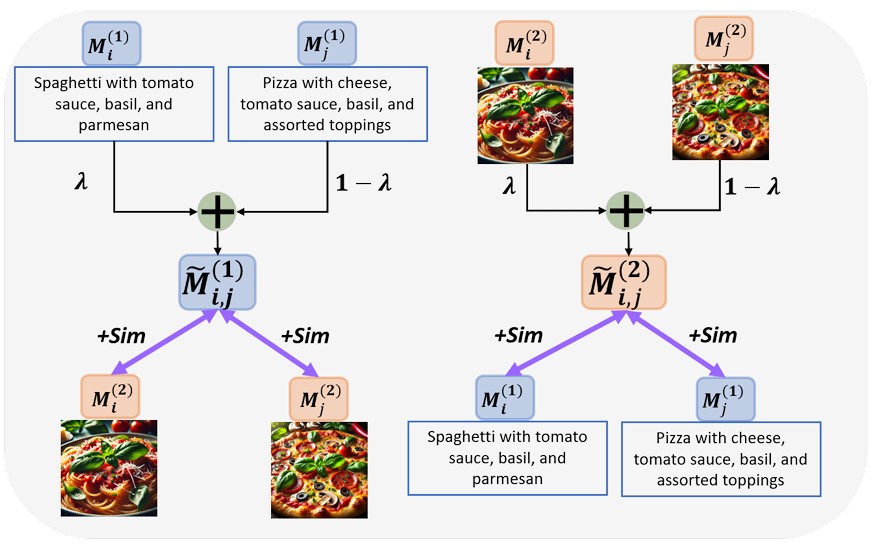
M3CoL: Harnessing Shared Relations via Multimodal Mixup Contrastive Learning for Multimodal Classification
Raja Kumar*, Raghav Singhal*, Pranamya Kulkarni, Deval Mehta, Kshitij Jadhav TMLR 2024 arXiv / code We introduce a multimodal mixup-based contrastive learning framework that effectively captures shared relations across modalities, enabling robust multimodal representation learning. |
|
Source code taken from Jon Barron's website. |